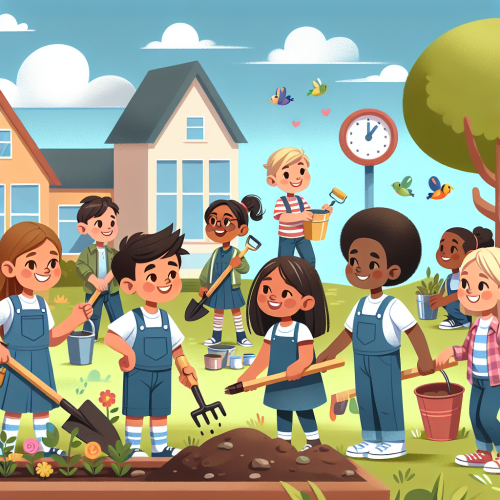
The purpose of this learning experience is to engage students in hands-on, community-focused projects that highlight the significance of teamwork. Through interactive activities, students will investigate how collaboration can address real-world challenges and enhance community well-being. By reflecting on their experiences, students will deepen their understanding of cause and effect, improve their communication skills, and cultivate a sense of belonging and identity within their community.
Learning goals
Students will explore the importance of teamwork in community building through hands-on problem-solving activities. They will practice effective communication by presenting their projects at a community fair, explaining the role of collaboration. Reflective activities, such as creating a mural, will help students understand their personal and collective growth. Language skills will be applied in both English and Spanish, emphasizing vocabulary related to cooperation. These experiences will support the development of self-directed learning, critical thinking, and a sense of belonging.
Standards
[National Council for the Social Studies] D4.7.3-5 - Explain different strategies and approaches students and others could take in working alone and together to address local, regional, and global problems, and predict possible results of their actions.
[California] L.2.1 - Demonstrate command of the conventions of standard English grammar and usage when writing or speaking.
[California] W.2.3 - Write narratives in which they recount a well-elaborated event or short sequence of events, include details to describe actions, thoughts, and feelings, use temporal words to signal event order, and provide a sense of closure.
[California] RI.2.3 - Describe the connection between a series of historical events, scientific ideas or concepts, or steps in technical procedures in a text.
[California] L.3.3 - Use knowledge of language and its conventions when writing, speaking, reading, or listening.
[California] W.3.3 - Write narratives to develop real or imagined experiences or events using effective technique, descriptive details, and clear event sequences.
[California] RI.3.1 - Ask and answer questions to demonstrate understanding of a text, referring explicitly to the text as the basis for the answers.
[California] L.4.3 - Use knowledge of language and its conventions when writing, speaking, reading, or listening.
[California] W.4.3 - Write narratives to develop real or imagined experiences or events using effective technique, descriptive details, and clear event sequences.
[California] RI.4.1 - Refer to details and examples in a text when explaining what the text says explicitly and when drawing inferences from the text.
Competencies
Self Directed Learning - Students use teacher and peer feedback and self-reflection to monitor and direct their own learning while building self knowledge both in and out of the classroom.
Academic Mindset - Students establish a sense of place, identity, and belonging to increase self-efficacy while engaging in critical reflection and action.
Critical Thinking & Problem Solving - Students consider a variety of innovative approaches to address and understand complex questions that are authentic and important to their communities.
Content Expertise - Students develop key competencies, skills, and dispositions with ample opportunities to apply knowledge and engage in work that matters to them.
Effective Communication - Students practice listening to understand, communicating with empathy, and share their learning through exhibiting, presenting and reflecting on their work.
Products
During the project, students will collaboratively create posters or models showcasing real-world examples of teamwork in their community, highlighting cause and effect relationships. By the end, they will contribute to a mural or art piece that encapsulates their insights on teamwork, displayed during the 'Reflection and Celebration Day.' Students will also prepare presentations for the community fair, effectively communicating their learning journey and the importance of collaboration in community building.
Launch
To kick off the learning experience, organize a "Community Helpers Day" where students meet local community members who exemplify teamwork in action, such as firefighters, librarians, or city council members. Each guest will share stories of how they collaborate with others to solve community issues. Following the presentations, students will engage in a hands-on activity, such as building a simple structure using blocks or recycled materials, to simulate the importance of teamwork and cooperation. This immersive introduction sets the stage for students to explore the essential question and sparks curiosity about the role of teamwork in their own lives.
Exhibition
Students will host a community fair where they present their posters or models demonstrating how teamwork has positively impacted their community. Each student will explain their project to community members, highlighting the importance of collaboration. This exhibition will also include a 'Reflection and Celebration Day,' where students create a collaborative mural or art piece representing teamwork, fostering a deeper understanding and appreciation of their collective efforts.