9th Grade  Project 4 weeks

Java Haven: Brew-tiful Room Design!

Shuangcai Z
CCSS.Math.Content.HSN-VM.C.6
9-12.AF.8.4
HS-PS2-3
CCSS.Math.Content.HSS-IC.B.4
CCSS.Math.Content.HSG-CO.C.10
+ 1 more
1-pager

Purpose

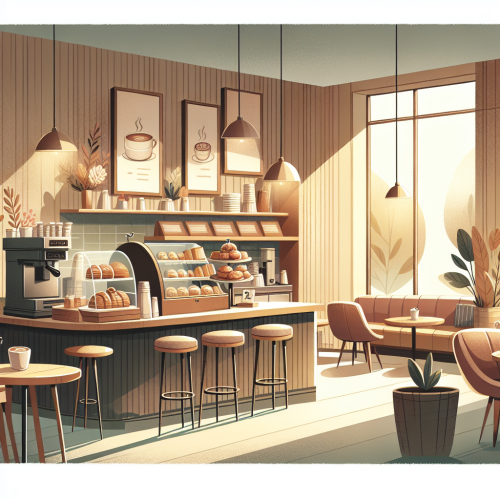
The purpose of this project is to engage 9th-grade students in a hands-on learning experience where they apply mathematical and scientific concepts in a real-world context by designing a coffee room. Students will collaborate with community partners, such as a local coffee shop owner, to gain practical insights into business design and customer experience. Throughout the project, students will develop self-directed learning skills, use reflection and critique to refine their designs, and ultimately create a business plan that showcases their understanding of budget constraints and user preferences.

Learning goals

Students will apply mathematical concepts, including matrices and data analysis, to design a functional coffee room layout that meets user needs and budget constraints. They will engage with community partners to gain real-world insights into coffee room design, customer experience, and business planning. Through self-directed learning, students will reflect on feedback to refine their designs and develop a comprehensive business plan. The project will culminate in an exhibition where students present their designs and plans to peers, demonstrating their understanding of scientific principles in minimizing force and evaluating design reliability.
Standards
  • [Common Core] CCSS.Math.Content.HSN-VM.C.6 - (+) Use matrices to represent and manipulate data, e.g., to represent payoffs or incidence relationships in a network.
  • [Next Generation Science Standards] 9-12.AF.8.4 - Evaluate the validity and reliability of and/or synthesize multiple claims, methods, and/or designs that appear in scientific and technical texts or media reports, verifying the data when possible.
  • [Next Generation Science Standards] HS-PS2-3 - Apply scientific and engineering ideas to design, evaluate, and refine a device that minimizes the force on a macroscopic object during a collision.
  • [Common Core] CCSS.Math.Content.HSS-IC.B.4 - Use data from a sample survey to estimate a population mean or proportion; develop a margin of error through the use of simulation models for random sampling.
  • [Common Core] CCSS.Math.Content.HSG-CO.C.10 - Prove theorems about triangles.
Competencies
  • Self Directed Learning - Students use teacher and peer feedback and self-reflection to monitor and direct their own learning while building self knowledge both in and out of the classroom.

Products

Students will collaboratively design a coffee room layout, incorporating mathematical concepts like matrices and triangle theorems to optimize space and customer flow. They will create a detailed business plan that includes budget analysis, customer experience strategies, and design elements influenced by feedback from community partners and peers. The final product will be presented in an exhibition to showcase their innovative coffee room design, supported by data-driven decisions and self-directed learning reflections.

Launch

Kick off the project by visiting a local coffee room to observe its design and atmosphere. Engage students in discussions with the coffee shop owner about the elements that contribute to a successful customer experience. Encourage students to take notes and gather ideas that will inform their own coffee room designs.

Exhibition

Students will present their coffee room designs and business plans to peers and school community members during a school exhibition event. They will showcase their understanding of layout, customer experience, and budget management through visual displays and oral presentations. Attendees will have the opportunity to provide feedback, fostering a collaborative learning environment and encouraging students to reflect on their work and make necessary revisions.