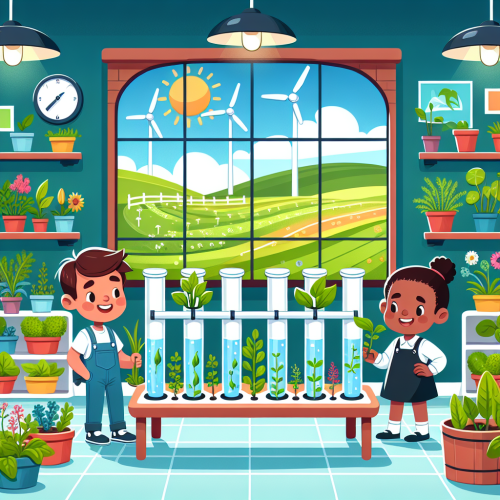
Students will engage in an AP Environmental Science-aligned exploration of hydroponics and climate change by constructing and managing their own hydroponic systems. Collaborating with Teens for Food Justice, they will gain practical insights into sustainable food production, critically analyze its role in reducing carbon footprints, and reflect on personal actions that address climate change. The project concludes with a recipe book featuring dishes made from their garden produce, demonstrating their comprehension and application of sustainable agricultural practices.
Learning goals
Students will explore the principles of hydroponics and its potential to reduce carbon footprints, aligning with AP Environmental Science standards. They will engage in hands-on activities to design and maintain a hydroponic system, assessing its environmental benefits. By collaborating with Teens for Food Justice, students will refine their self-directed learning and communication skills, ultimately producing a recipe book that highlights their locally grown produce.
Standards
[National Core Arts Standards] TH:Cr1.HS2.c - Use personal experiences and knowledge to develop a character that is believable and authentic in a drama/theatre work.
[National Core Arts Standards] TH:Pr4.HS1.b - Shape character choices using given circumstances in a drama/theatre work.
[National Core Arts Standards] MA:Re7.1.ii.a - HS Accomplished: Analyze and synthesize the qualities and relationships of the components in a variety of media artworks, and feedback on how they impact audience.
[National Core Arts Standards] DA:Pr4.1.III.b - Modulate time factors for artistic interest and expressive acuity. Demonstrate time complexity in phrasing with and without musical accompaniment. Use multiple and complex rhythms (for example, contrapuntal and/or polyrhythmic) at the same time. Work with and against rhythm of accompaniment or sound environments.
[National Core Arts Standards] MA:Re7.1.i.b - HS Proficient: Analyze how a variety of media artworks manage audience experience and create intention through multimodal perception.
Competencies
Self Directed Learning - Students use teacher and peer feedback and self-reflection to monitor and direct their own learning while building self knowledge both in and out of the classroom.
Academic Mindset - Students establish a sense of place, identity, and belonging to increase self-efficacy while engaging in critical reflection and action.
Critical Thinking & Problem Solving - Students consider a variety of innovative approaches to address and understand complex questions that are authentic and important to their communities.
Content Expertise - Students develop key competencies, skills, and dispositions with ample opportunities to apply knowledge and engage in work that matters to them.
Effective Communication - Students practice listening to understand, communicating with empathy, and share their learning through exhibiting, presenting and reflecting on their work.
Products
Students will collaboratively design and construct small-scale hydroponic systems, documenting their process and results through a multimedia presentation aligned with AP Environmental Science standards. They will also compile a recipe book featuring dishes made from the vegetables they grow, highlighting the benefits of local food production. Additionally, students will create a reflective essay or video discussing how hydroponics can be a personal choice contributing to climate change mitigation.
Launch
Begin the project with an interactive workshop facilitated by Teens for Food Justice (TFFJ) that explores the role of hydroponics in reducing carbon footprints and promoting sustainability, aligned with AP Environmental Science standards. Students will collaboratively design and construct their own small-scale hydroponic systems, fostering engagement and curiosity. Conclude the session by posing the essential question, prompting students to brainstorm and discuss initial ideas on the potential of hydroponics in sustainable agriculture.
Exhibition
Students will host a community event where they showcase their hydroponic systems and present a recipe book featuring dishes made with vegetables grown in their setups. They will engage attendees with interactive demonstrations on how hydroponics can contribute to sustainable living and climate change mitigation, aligning with AP Environmental Science standards. Each student will narrate their personal journey and reflections on how growing their own food has impacted their understanding of climate change and sustainable practices.