4th Grade  Lesson 45 minutes

Migration Mysteries: Unraveling Our Roots

OMAR M
CCSS.Math.Content.4.G.A.2
CCSS.Math.Content.4.NF.C.6
CCSS.Math.Content.4.NBT.A.1
Self Directed Learning
1-pager

Purpose

This learning experience aims to deepen students' understanding of their identities and communities through the exploration of migration stories. By engaging in activities like creating a migration map, conducting interviews, and sharing narratives, students connect personal and collective histories to broader themes of movement and change. The project fosters self-directed learning, empathy, and critical thinking, as students reflect on how migration shapes lives and influences perspectives.

Learning goals

Students will develop an understanding of how migration stories shape individual and community identities by engaging in storytelling and active listening. They will enhance their interviewing skills by formulating and refining questions to gather meaningful migration narratives from caregivers. Through self-directed learning, students will reflect on their own family histories, fostering a deeper connection to their personal and communal identities. Additionally, students will apply mathematical concepts by classifying geometric figures and using decimal notation, integrating these skills into their storytelling projects.
Standards
  • [Common Core] CCSS.Math.Content.4.G.A.2 - Classify two-dimensional figures based on the presence or absence of parallel or perpendicular lines, or the presence or absence of angles of a specified size. Recognize right triangles as a category, and identify right triangles.
  • [Common Core] CCSS.Math.Content.4.NF.C.6 - Use decimal notation for fractions with denominators 10 or 100.
  • [Common Core] CCSS.Math.Content.4.NBT.A.1 - Recognize that in a multi-digit whole number, a digit in one place represents ten times what it represents in the place to its right.
Competencies
  • Self Directed Learning - Students use teacher and peer feedback and self-reflection to monitor and direct their own learning while building self knowledge both in and out of the classroom.

Products

Students will create digital presentations of their family migration stories, incorporating photos, letters, or artifacts to enhance their narratives. These presentations will be shared during a 'Migration Storytelling Festival' with classmates, parents, and community members. Additionally, students will develop a gallery walk exhibit, displaying their migration artifacts alongside written narratives that connect personal experiences to the essential questions.

Launch

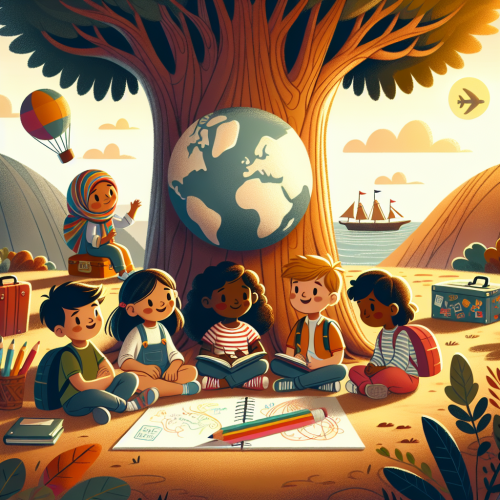
Begin with a 'Migration Map Adventure' where students collaboratively create a large world map in the classroom. Have students place markers on countries their families migrated from and share brief stories about each location. Encourage students to connect these stories to the essential questions, fostering an understanding of how migration shapes identity and community.

Exhibition

Host a 'Migration Storytelling Festival' where students present their family migration stories through digital presentations to classmates, parents, and community members. Arrange a gallery walk where students display artifacts, letters, or photos related to their family's migration history, accompanied by written narratives. Encourage students to engage with visitors by answering questions and sharing insights about their projects, fostering a deeper understanding of migration's impact on identity and community.