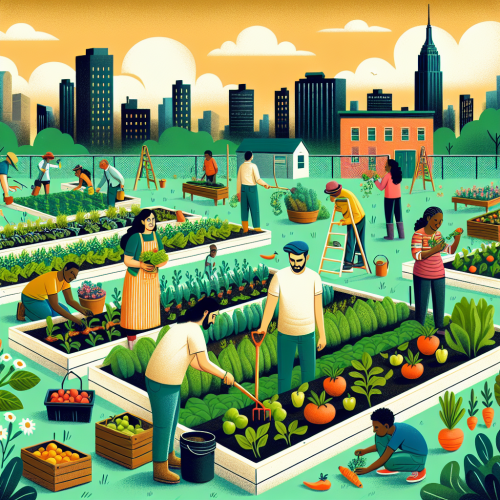
The purpose of this project is to immerse 5th-grade students in a hands-on exploration of food justice and green spaces in Elmhurst, NY, fostering a deeper understanding of ecological harmony and community impact. Students will engage in critical inquiry, design sustainable garden models, and experiment with hydroponics systems, applying their learning to address real-world challenges. Through collaboration with community partners, students will reflect on cultural perspectives and advocate for equitable access to nutritious food and green spaces, enhancing their sense of belonging and identity.
Learning goals
I can locate and refer to relevant details and evidence when explaining texts related to food justice and green spaces, making logical inferences about their impact on Elmhurst. I can accurately use academic and content-specific words and phrases to express ideas about food justice, equity, and sustainability. I can write informative and persuasive texts to explore topics related to food justice and propose actionable strategies for community improvement. I can conduct research and engage in collaborative discussions to deepen my understanding of how humans can live harmoniously with plants and animals, using insights from my reflection journal and community garden model. I can demonstrate my learning through the design and presentation of a hydroponics system model, showcasing innovative approaches to enhancing food security.
Standards
[New York] 5R1 - Locate and refer to relevant details and evidence when explaining what a text says explicitly/implicitly and make logical inferences.
[New York] 5L6 - Acquire and accurately use general academic and content-specific words and phrases, including those that signal contrast, addition, and other logical relationships (e.g., however, although, nevertheless, similarly, moreover, in addition).
[New York] 5L5 - Demonstrate understanding of figurative language, word relationships, and nuances in word meanings.
[New York] 5L4 - Determine or clarify the meaning of unknown and multiple-meaning words and phrases, choosing flexibly from a range of strategies.
[New York] 5L3 - Use knowledge of language and its conventions when writing, speaking, reading, or listening.
[New York] 5R4 - Determine the meaning of words, phrases, figurative language, academic, and content- specific words and analyze their effect on meaning, tone, or mood.
[New York] 5R8 - Explain how claims in a text are supported by relevant reasons and evidence, identifying which reasons and evidence support which claims.
[New York] 5W1 - Write an argument to support claims with clear reasons and relevant evidence.
[New York] 5W2 - Write informative/explanatory texts to explore a topic and convey ideas and information relevant to the subject.
[New York] 5W5 - Draw evidence from literary or informational texts to respond and support analysis, reflection, and research by applying the Grade 5 Reading Standards.
[New York] 5W6 - Conduct research to answer questions, including self-generated questions, and to build knowledge through investigation of multiple aspects of a topic using multiple sources.
[New York] 5SL1 - Engage effectively in a range of collaborative discussions with diverse partners; express ideas clearly and persuasively, and build on those of others.
[New York] 5R2 - Determine a theme or central idea and explain how it is supported by key details; summarize a text.
[New York] 5R6 - In literary texts, explain how a narrator's or speaker's point of view influences how events are described. In informational texts, analyze multiple accounts of the same event or topic, noting important similarities and differences in the point of view they represent.
[New York] 5R9 - Use established criteria to categorize texts and make informed judgments about quality; make connections to other texts, ideas, cultural perspectives, eras and personal experiences.
[New York] 5W7 - Recall relevant information from experiences or gather relevant information from multiple sources; summarize or paraphrase; avoid plagiarism and provide a list of sources.
Competencies
Self Directed Learning - Students use teacher and peer feedback and self-reflection to monitor and direct their own learning while building self knowledge both in and out of the classroom.
Academic Mindset - Students establish a sense of place, identity, and belonging to increase self-efficacy while engaging in critical reflection and action.
Critical Thinking & Problem Solving - Students consider a variety of innovative approaches to address and understand complex questions that are authentic and important to their communities.
Content Expertise - Students develop key competencies, skills, and dispositions with ample opportunities to apply knowledge and engage in work that matters to them.
Effective Communication - Students practice listening to understand, communicating with empathy, and share their learning through exhibiting, presenting and reflecting on their work.
Products
Students will collaboratively design and construct a small-scale community garden model using sustainable materials, showcasing their understanding of urban green spaces and food justice. Additionally, they will create a live demonstration of hydroponics or aquaponics systems, explaining the science behind these sustainable farming methods and their potential to enhance food security. These projects will be displayed at the 'Harmony with Nature Festival,' where students will present their innovative solutions and engage the Elmhurst community in discussions about food justice and environmental stewardship.
Launch
Begin the project with a storytelling session featuring excerpts from "Braiding Sweetgrass" to introduce students to themes of interconnectedness and reciprocity. Follow this with an interactive discussion on the concept of a gift economy and food justice, encouraging students to share their initial thoughts and questions. Conclude the launch by organizing a visit to a local community garden, where students can observe sustainable practices and connect the themes discussed to real-world examples in Elmhurst.
Exhibition
Students will organize a 'Harmony with Nature Festival' where they present their community garden model and demonstrate hydroponics or aquaponics systems to showcase sustainable farming methods. The festival will include student-led presentations, performances, and art installations that explore living harmoniously with plants and animals, aligned with the essential question. Students will share insights from family interviews and cultural food experiences, fostering community engagement and dialogue on food justice and green spaces in Elmhurst, while reflecting on their learning goals through "I can" statements.
Copied from
Elmhurst Eats & Green Streets Adventure