All grades  Project 4 weeks

Eco-Engineers: Combustion with a Green Twist!

Bryce H
PS.Chm.4.2
PS.Chm.4.3
PS.Chm.4.4
PS.Chm.5.1
PS.Chm.4.1
+ 1 more
1-pager

Learning goals

Students will investigate the chemistry of combustion reactions and alternative fuels, applying stoichiometry and the Law of Conservation of Mass to predict reaction outcomes and environmental impacts. They will develop computational thinking skills by analyzing the composition of substances and using models to explain chemical changes. Through collaboration with automotive engineers, students will gain real-world insights into eco-friendly innovations, fostering critical thinking and problem-solving abilities. The project emphasizes hands-on experimentation, data interpretation, and iterative design processes to develop a new chemical reaction for car engines that reduces carbon emissions.
Standards
  • [North Carolina] PS.Chm.4.2 - Carry out investigations to predict the outcome of simple chemical reactions that obey the Law of Conservation of Mass.
  • [North Carolina] PS.Chm.4.3 - Use mathematics and computational thinking to analyze quantitatively the composition of a substance (empirical formula, molecular formula, percent composition, and mole conversions).
  • [North Carolina] PS.Chm.4.4 - Use mathematics and computational thinking to apply the mole concept in the stoichiometric relationships inherent in chemical reactions.
  • [North Carolina] PS.Chm.5.1 - Carry out investigations to explain the effects of temperature, surface area, stirring, the concentration of reactants, and the presence of catalysts on the rate of chemical reactions according to Collision Theory.
  • [North Carolina] PS.Chm.4.1 - Use models to explain the exothermic or endothermic nature of chemical changes.
  • [North Carolina] PS.Chm.5.2 - Analyze and interpret data to predict how stressors on a reaction (concentration, temperature, pressure) would shift equilibrium.

Products

Students will create a digital presentation that outlines their process of designing an innovative chemical reaction for car engines, incorporating visual models and simulations to demonstrate its environmental impact. They will also organize a live demonstration to showcase their experiments, highlighting their predictions and calculations using stoichiometry and the Law of Conservation of Mass. Throughout the project, students will document their progress and revisions in a 'Feedback Loop Journal,' capturing insights from peers and experts to refine their final products.

Launch

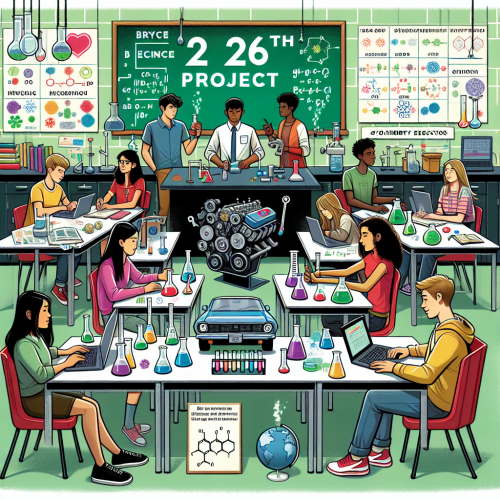
Begin the project with an immersive 'Future Fuels Workshop' where students participate in hands-on mini-labs exploring alternative fuel chemistry. Invite guest speakers from the automotive industry to discuss the innovations and challenges in creating eco-friendly engine technologies. Encourage students to ask questions and interact with experts, setting the stage for their own research and development of new chemical reactions for car engines.

Exhibition

At the conclusion of the project, students will host a "Green Engine Expo" where they will showcase their digital presentations and live demonstrations to an audience of peers, teachers, and community partners. Each student group will have a booth to display their chemical reaction designs, simulations, and stoichiometric calculations, highlighting the environmental benefits of their innovations. Attendees will have the opportunity to engage with students, ask questions, and provide feedback, fostering a collaborative environment that emphasizes real-world application and impact.