6th Grade  Project 5 weeks

City Slickers: Mastering Urban Efficiency!

Deborah M
Self Directed Learning
1-pager

Purpose

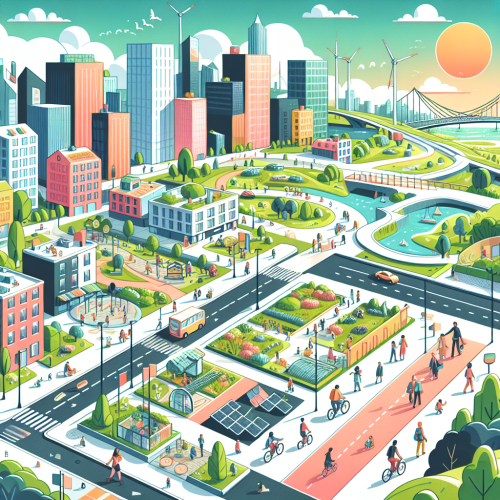
The purpose of this project is to immerse students in the dynamic world of city planning, where they apply mathematical concepts to design an efficient city or travel system. Through hands-on activities and real-world simulations, students explore relationships, proportionality, and patterns to optimize city functionality and enhance quality of life. This experience fosters critical thinking, collaboration, and self-directed learning, as students engage with authentic challenges and present their solutions to a public audience, developing both mathematical proficiency and civic awareness.

Learning goals

Students will develop skills in representing mathematical relationships through tables, graphs, and equations, enabling them to design efficient city layouts and transportation systems. They will analyze independent and dependent variables to understand their impact on city functionality and explore proportional and nonproportional relationships to optimize travel routes and reduce bottlenecks. Through hands-on activities and collaborative problem-solving, students will apply mathematical principles to real-world scenarios, fostering critical thinking and creativity in city planning. They will engage in self-directed learning, using feedback and reflection to enhance their designs and mathematical justifications.
Standards
  • [Next Generation Science Standards] MS-ETS1-2 - Evaluate competing design solutions using a systematic process to determine how well they meet the criteria and constraints of the problem.
Competencies
  • Self Directed Learning - Students use teacher and peer feedback and self-reflection to monitor and direct their own learning while building self knowledge both in and out of the classroom.

Products

Students will create comprehensive city maps that illustrate their design and planning decisions, accompanied by detailed travel route analyses using tables and graphs. They will compile a Relationship Justification Report, articulating the mathematical principles behind their city layouts and transportation systems. The final presentation to a simulated "City Council" will showcase their city designs and the efficiency improvements proposed, supported by mathematical evidence. Additionally, students will design posters or infographics that visually communicate the mathematical relationships and data analysis integral to their city planning process.

Launch

Kick off the project with a 'Mathematical City Tour,' where students rotate through interactive stations, each highlighting a key mathematical concept relevant to city planning, such as proportionality or graphing. At each stop, students engage in hands-on activities that challenge them to apply these concepts to real-world scenarios, fostering curiosity and setting the stage for deeper exploration. This immersive experience will ignite interest and provide a foundational understanding of the mathematical principles they will use throughout the project.

Exhibition

Students will participate in a 'Math in Motion Fair,' where they showcase their city designs through interactive simulations and hands-on activities that demonstrate traffic flow and travel time concepts. Additionally, they will engage in a 'City Design Symposium,' presenting their projects and discussing the mathematical relationships that influenced their designs with peers and visitors. These events will provide students with opportunities to explain their work to an authentic audience, including assistant principals, STEM teachers, and parents, fostering a deeper understanding of the project's real-world applications.