All grades  Project 9 weeks

Wild Wild West Adventures: Early American Tales

Christine H
ELA.2.L.1
ELA.2.L.2
ELA.2.L.2.a
ELA.2.L.2.b
ELA.2.L.2.d
+ 29 more
1-pager

Purpose

This project aims to immerse students in the historical context of early American life in the West through interactive, hands-on experiences. By engaging in role-playing, collaborative art, and community partnerships, students will explore the challenges and cultural exchanges between early Americans and Native American tribes. The project fosters critical thinking, effective communication, and collaboration skills, allowing students to connect historical events to their own lives and develop a deeper understanding of cultural and societal development.

Learning goals

Students will explore the daily life and challenges faced by early Americans in the West, understanding the cultural and societal impacts of their interactions with Native American tribes. Through hands-on activities and collaborative projects, students will develop vocabulary and language skills aligned with Wisconsin ELA standards, while enhancing critical thinking and problem-solving abilities. The project aims to foster self-directed learning and effective communication, encouraging students to reflect on historical contexts and express their understanding creatively through exhibitions and performances.
Standards
  • [Wisconsin] ELA.2.L.1 - Demonstrate an understanding of how language functions in different cultures and contexts; apply this knowledge to comprehend more fully when reading and listening, and make effective choices when composing, creating, and speaking.
  • [Wisconsin] ELA.2.L.2 - Determine or clarify the meaning of unknown and multiple-meaning words and phrases in grade-level reading and content; use context clues, analyze meaningful word parts, consult general and specialized reference materials, and apply word solving strategies (for meaning) as appropriate.
  • [Wisconsin] ELA.2.L.2.a - Determine the meaning of a new word when a prefix or suffix is added.
  • [Wisconsin] ELA.2.L.2.b - Use a common root word as a clue to the meaning of an unknown word.
  • [Wisconsin] ELA.2.L.2.d - Use resources to clarify meanings of words.
  • [Wisconsin] ELA.2.L.4 - Demonstrate an ability to collaboratively and independently build vocabulary knowledge when encountering unknown words including cultural, general academic, and discipline-specific terms and phrases; use vocabulary appropriate to the context and situation. Use adjectives and adverbs to describe (e.g., when other kids are happy, that makes me happy.).
  • [Wisconsin] ELA.2.L.5.a - Collective nouns, adjectives and adverbs, frequently occurring regular plural nouns, frequently occurring irregular past tense verbs.
  • [Wisconsin] ELA.2.L.5.b - Production, expansion, and rearrangement of complete simple and compound sentences.
  • [Wisconsin] ELA.2.L.6 - Demonstrate contextually appropriate use of the conventions of standardized English capitalization, punctuation, and spelling when writing. Discern when and where it is appropriate to use standardized English. Appropriately use and explain the intended purpose in conventions with:
  • [Wisconsin] ELA.2.L.6.a - Capitalization of holidays, products, geographic places.
  • [Wisconsin] ELA.2.L.6.d - Use common spelling patterns, phonemic awareness, and basic reference materials to solve words.
  • [Wisconsin] ELA.2.R.2 - Summarize portions of a text in order to identify a main topic or central idea and key details in a text. (RI&RL)
  • [Wisconsin] ELA.2.R.1 - Develop and answer questions to demonstrate an understanding of key ideas and details in a text. (RI&RL)
  • [Wisconsin] ELA.2.R.3 - Describe how characters respond to major events and challenges. (RL) Describe the connections between ideas, concepts, or a series of events. (RI)
  • [Wisconsin] ELA.2.R.5 - Describe the overall structure of a text, including describing how the beginning introduces the text and the ending concludes the text. (RI&RL)
  • [Wisconsin] ELA.2.W.2 - Write text in a variety of modes:
  • [Wisconsin] ELA.2.W.2.b - Informative/explanatory text in which they introduce a topic, use facts and definitions to develop points, and provide a concluding statement or section.
  • [Wisconsin] ELA.2.W.3.a - Organization: provide a beginning, middle and ending, that works cohesively to promote the central theme of the text.
  • [Wisconsin] ELA.2.W.3.b - Transitions: use transitions to link and build connections between ideas, text, and events.
  • [Wisconsin] ELA.2.W.3.c - Word Choice (including domain specific): uses descriptive words to demonstrate creativity and to provide vivid examples of feelings, events and images.
  • [Wisconsin] ELA.2.W.5 - With guidance and support from adults and peers, focus on a topic and strengthen writing as needed by revising and editing.
  • [Wisconsin] ELA.2.W.6 - With guidance and support from adults, use a variety of digital tools to produce and publish writing, including in collaboration with peers. Learn to produce writing through printing (including forming most printed upper and lower case letters), cursive, and/or typing.
  • [Wisconsin] ELA.2.W.8 - Recall information from experiences or gather information from provided sources to answer a question.
  • [Wisconsin] ELA.2.W.9 - With guidance and support from adults and peers, recall and use facts from literary and informational text to support reflection and inquiry on characters, setting, key details, specified information, and ideas presented in a text.
  • [Wisconsin] ELA.2.SL.1 - Participate in collaborative conversations with diverse partners about topics and texts with peers and adults in small and larger groups.
  • [Wisconsin] ELA.2.SL.1.a - Follow agreed-upon norms for discussions and participate by actively listening, taking turns, gaining the floor in respectful ways and staying on topic.
  • [Wisconsin] ELA.2.SL.1.b - Build on others' talk in conversations by linking their comments to the remarks of others.
  • [Wisconsin] ELA.2.SL.1.d - Consider individual differences when communicating with others.
Competencies
  • Self Directed Learning - Students use teacher and peer feedback and self-reflection to monitor and direct their own learning while building self knowledge both in and out of the classroom.
  • Academic Mindset - Students establish a sense of place, identity, and belonging to increase self-efficacy while engaging in critical reflection and action.
  • Critical Thinking & Problem Solving - Students consider a variety of innovative approaches to address and understand complex questions that are authentic and important to their communities.
  • Content Expertise - Students develop key competencies, skills, and dispositions with ample opportunities to apply knowledge and engage in work that matters to them.
  • Effective Communication - Students practice listening to understand, communicating with empathy, and share their learning through exhibiting, presenting and reflecting on their work.
  • Collaboration - Students co-design projects with peers, exercise shared-decision making, strengthen relational agency, resolve conflict, and assume leadership roles.

Products

Throughout the project, students will collaboratively design and construct a 'Model Homestead' using materials like cardboard and clay, representing early American homes and landscapes. They will also create a collaborative mural depicting scenes of early American life in the West, incorporating learned vocabulary and concepts. By the end, students will present their homesteads and murals in a community exhibition, explaining their historical significance and context. Additionally, students will write and perform short plays or skits, in partnership with a local theater group, showcasing their understanding of historical events and cultural exchanges.

Launch

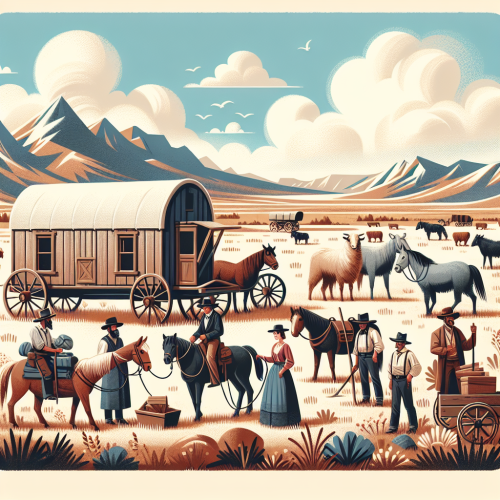
Begin the project with a dynamic 'Pioneer Day' event where students dress as early Americans and engage in interactive stations such as candle making, butter churning, and wagon building. This immersive experience will spark curiosity and excitement about life in the West for early Americans. Complement the day with a 'Trailblazers' Treasure Hunt,' where students work in teams to follow a map, uncover hidden artifacts, and solve clues related to early American history, fostering teamwork and problem-solving skills.

Exhibition

Students will host a 'History in Motion' event, performing short plays or skits that bring to life the experiences and interactions of early Americans and Native American tribes. Collaborating with a local theater group, students will creatively express their understanding of historical events and cultural exchanges. This community exhibition will also feature student-created artifacts and models representing aspects of early American life, allowing them to explain their significance and historical context to visitors.