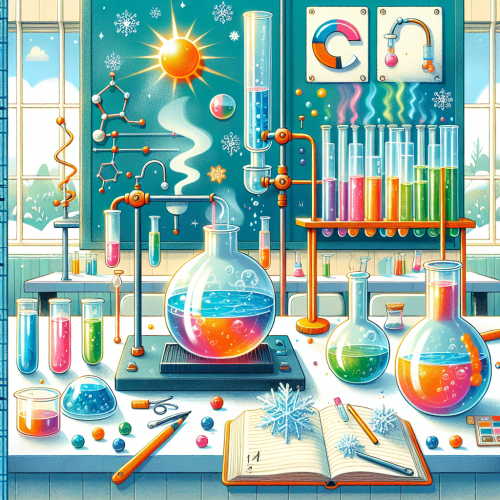
Students will engage in hands-on experiments to explore the concepts of mixtures and solutions, applying scientific principles to real-world contexts. By working collaboratively in the school's kitchen and lab, they will refine their understanding through practical applications such as distilling seawater and creating borax snowflakes. This project-based approach will encourage students to reflect on their learning process, utilize feedback for self-directed growth, and critically analyze the role of mixtures and solutions in everyday life. Through this experience, students will showcase their findings and deepen their sense of belonging and identity within the classroom community.
Learning goals
Students will explore the properties and applications of mixtures and solutions by engaging in hands-on experiments such as distilling seawater and making borax snowflakes. They will collaborate with peers in the school kitchen to understand the role of mixtures and solutions in culinary processes, fostering a sense of belonging and identity within the classroom community. Through critical reflection, students will refine their understanding of chemical systems and apply innovative problem-solving skills to real-world scenarios. By the end of the unit, students will display their projects, demonstrating their ability to connect scientific concepts to everyday life and their community.
Standards
[Next Generation Science Standards] HS-PS1-6 - Refine the design of a chemical system by specifying a change in conditions that would produce increased amounts of products at equilibrium.
Competencies
Self Directed Learning - Students use teacher and peer feedback and self-reflection to monitor and direct their own learning while building self knowledge both in and out of the classroom.
Academic Mindset - Students establish a sense of place, identity, and belonging to increase self-efficacy while engaging in critical reflection and action.
Critical Thinking & Problem Solving - Students consider a variety of innovative approaches to address and understand complex questions that are authentic and important to their communities.
Products
Students will create a series of projects that demonstrate their understanding of mixtures and solutions, including a distilled seawater sample, a separated iron and sulfur mixture, and borax snowflakes. Each student will document their process and findings in a digital lab journal, which will be shared with peers for feedback. The final exhibition will involve a classroom showcase where students present their projects, explaining the real-world applications of their experiments and reflecting on their learning journey.
Launch
Begin the lesson by inviting students to the school kitchen to explore everyday mixtures and solutions they encounter, such as salad dressings, coffee, and smoothies. Encourage students to identify the solutes and solvents in each example and discuss whether they are homogeneous or heterogeneous mixtures. Facilitate a brief discussion on how these mixtures and solutions impact their daily lives, leading to the essential question of the unit. This hands-on exploration sets the stage for deeper inquiry and real-world application throughout the unit.
Exhibition
Students will showcase their understanding of mixtures and solutions by creating interactive displays that highlight their lab projects, such as distilling seawater or making borax snowflakes. These displays will be set up in the classroom, transforming it into a mini science fair where peers, teachers, and community members, including the kitchen staff, can engage with the students' work. Each student will present their process, findings, and the real-world applications of their projects, fostering a sense of community and shared learning.